
Views: 0 Author: Site Editor Publish Time: 2026-08-14 Origin: Site
No. High-quality anti-fingerprint film does not affect the touchscreen responsiveness. Industry testing confirms that oil-repellent coating film maintain a correct recipe while providing smudge resistance, still keeping complete touch sensitivity. The touchscreen function relies on capacitive sensing, which detects the electrical conductivity of a finger. An appropriately thin anti-fingerprint film for screen does not interfere with this signal transmission.
Mr.Film's anti-fingerprint products are designed for touchscreen applications, balancing optical clarity, anti-fingerprint resistance and full touch sensitivity. The key to keeping responsiveness lies in three factors: film thickness, dielectric properties of the material, and surface hardness. When these parameters are correctly specified, the touchscreen can be expected to work normally whether a protect film is applied or not.


Modern touchscreens use capacitive sensing technology. The screen generates a uniform electrostatic field across its surface. When a finger (which is electrically conductive) touches the screen, it draws a small amount of current to the point of contact, creating a measurable change in the electrostatic field. This change is detected by the device's controller, which calculates the exact touch location.
The critical point is that the screen detects the finger's electrical conductivity, not physical pressure. This is why a thin, non-conductive layer (like a quality screen protector) does not prevent the touchscreen from functioning.
Industry research confirms that touchscreen films thinner than 0.2 mm have negligible effect on responsiveness.
Film Thickness | Responsiveness Impact | Typical Application |
< 0.1 mm | No measurable effect | Standard anti-fingerprint films |
0.1–0.2 mm | Minimal (imperceptible) | Premium films with oleophobic coating |
> 0.2 mm | Potential reduction | Thick tempered glass protectors |
Mr. Film's anti-fingerprint films are manufactured with thicknesses below 0.2 mm to ensure full touch sensitivity across all devices.
The primary physical factor affecting touchscreen responsiveness is the distance between the finger and the capacitive sensor. Thicker films increase this distance, which can slightly reduce the capacitive coupling between the finger and the sensor. However, modern touchscreen controllers are designed to compensate for protective layers up to approximately 0.3 mm thick. Films thinner than 0.2 mm do not interfere with this compensation range.
Industry product specifications confirm that anti-fingerprint films maintain full touch sensitivity when properly formulated. Manufacturers document that their films are engineered to preserve touchscreen operation.
The dielectric constant of the film material affects how the electrostatic field propagates. Materials with a low dielectric constant (such as PET, which is commonly used in screen protectors) allow the field to pass through without significant attenuation.
Mr. Film's anti-fingerprint products use PET substrates with optimized dielectric properties, ensuring field penetration for accurate touch detection.
The oleophobic coating on anti-fingerprint films changes the surface feel, not the electrical response. The coating reduces friction, allowing fingers to glide smoothly. This improved tactile experience often leads users to perceive the screen as more responsive, even though the underlying sensitivity is unchanged.
Important note: The "feel" of responsiveness and the actual electrical sensitivity are different concepts. The film does not slow the screen's response to touch; it simply makes swiping and dragging motions more comfortable.

The belief that screen protectors reduce touchscreen responsiveness is primarily associated with two scenarios:
Early resistive touchscreens used pressure sensing, and thick protectors could dampen the required pressure. These screens are now obsolete in smartphones and tablets.
Poor-quality thick protectors (over 0.3 mm) with low-quality adhesive can create an air gap between the screen and the film, reducing capacitive coupling. This is an installation or material issue, not an inherent problem with protective films.
Quality anti-fingerprint films manufactured to appropriate thickness specifications do not produce this effect.
Anti-fingerprint films are coated with an oleophobic (oil-repelling) layer that reduces fingerprint marks. The coating is applied as an ultra-thin layer over the PET substrate. This coating is:
l Optically transparent (does not block light)
l Electrically transparent (does not interfere with the electrostatic field)
l Chemically bonded (does not transfer to the finger during use)
The coating's thickness is measured in nanometers (billionths of a meter). It is not a separate layer but a surface treatment, and it does not contribute to the film's thickness or affect capacitive coupling.
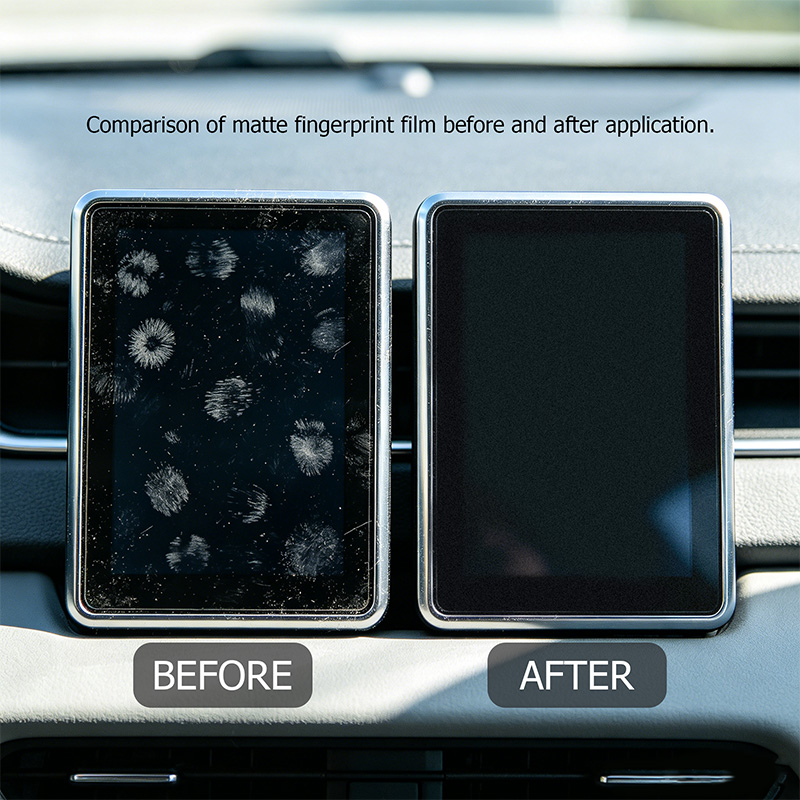
While fingerprints themselves do not affect touchscreen sensitivity, they can scatter light and reduce visibility. Anti-fingerprint film works by reducing the visibility of these oils, allowing a clean, smudge-free surface that makes reading and typing easier. This improved visibility is often interpreted as improved clarity and responsiveness.
Characteristic | Bare Touchscreen | Mr. Film Anti-Fingerprint |
Touch sensitivity | 100% | 100% (no reduction) |
Screen clarity | 100% | ≥ 95% |
Fingerprint visibility | High (visible smudges) | Low (minimal marks) |
Glide smoothness | Moderate | High (reduced friction) |
Screen protection | None | Scratch, impact, UV |
Q: What if I notice reduced responsiveness after installing the film?
A: Reduced responsiveness is typically caused by dust or air bubbles trapped between the film and the screen, not by the film itself. Clean the screen thoroughly and reinstall the film to eliminate any trapped material. If the problem persists, the film may be too thick.
Q: How do I maintain the film without reducing responsiveness?
A: Use a microfiber cloth for cleaning. Avoid abrasive materials. The film's sensitivity remains constant throughout its life; maintenance affects clarity and smudge resistance.
Q: Does Mr. Film anti-fingerprint film work on curved edge screens?
A: Mr. Film products are available in formulations designed for curved displays, with specific thickness and adhesive properties for edge coverage while maintaining full sensitivity.
Q: Does the oleophobic coating wear off and affect touch response over time?
A: The oleophobic coating may wear down with extended use, which reduces the film’s smudge‑resistant properties. However, the touch sensitivity remains entirely unaffected because it depends on the film’s thickness and dielectric properties, not the coating.
Q: Does the film work with screen protectors already on the device?
A: Mr. Film’s anti-fingerprint film is designed as a standalone screen protector. It is not intended to be applied over an existing protector, as stacking layers may increase total thickness and potentially affect responsiveness.


