
Views: 0 Author: Site Editor Publish Time: 2026-10-26 Origin: Site
Choosing the right window film for your house is no longer just about reducing glare. It is about cutting solar heat, protecting your family and your furniture from UV, and keeping energy bills under control at the same time. As more homeowners search for practical ways to manage indoor temperature without drawing the curtains all day, home window tint has become one of the most requested upgrades for both new builds and renovations.
Unlike curtains or blinds, window film works around the clock, filtering heat and light even when windows stay uncovered. This guide explains what solar control film can and cannot do, how the main film constructions compare, and what to check before you buy.
Rising energy costs have pushed many households to look at their windows as a source of waste rather than just a design feature. Untreated glass allows a significant share of solar heat to pass directly into a room, forcing air conditioning systems to work harder throughout the day.
A quality building window film addresses this by reflecting or absorbing a portion of incoming solar energy before it reaches the interior. Current film constructions in the range reject between 91% and 98% of infrared radiation, which translates into a measurable drop in cooling load during peak summer months while also reducing fading on floors, fabric and furniture caused by prolonged UV exposure.
Privacy is often a welcome side effect rather than the main reason to buy. Films with a mild mirror finish make it difficult to see in from the street during daylight while keeping the outward view clear, which matters for ground-floor rooms and street-facing windows. It is still a heat-control film first: the one-way mirror model MRW7590, for example, delivers 70% visible light transmission alongside 91% infrared rejection, so the privacy does not come at the expense of solar control.
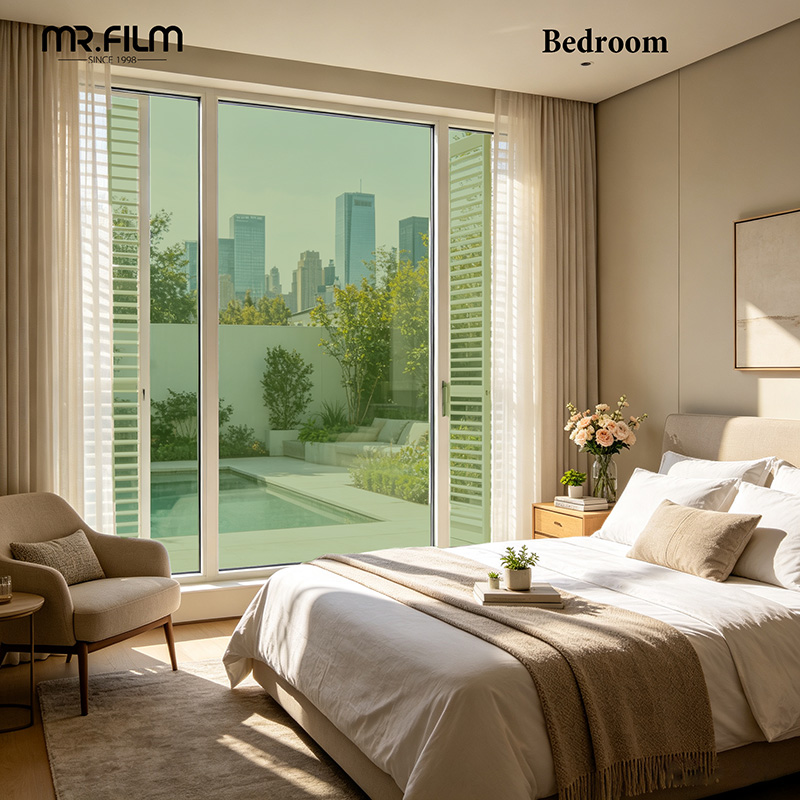
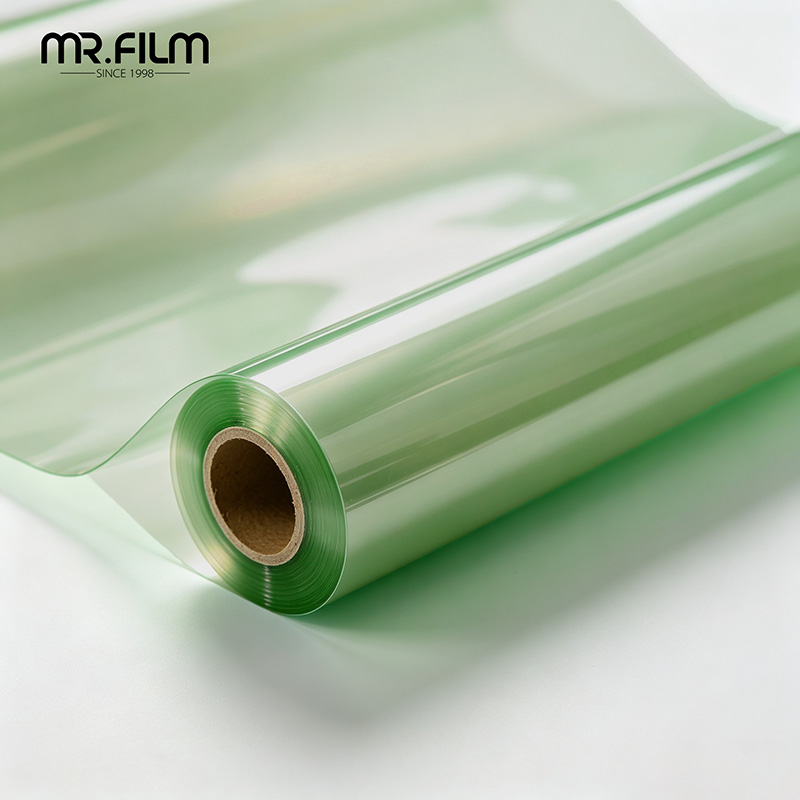
Not all window film is built the same way, and the differences matter when you are shopping for your own home. Commercial buildings often prioritise uniform appearance across large glass facades, while residential window tint is typically selected room by room, with orientation, glazing type and daily routine all influencing the specification.
The specification should follow the room, not the other way round. A west-facing kitchen or a living room with floor-to-ceiling glazing needs higher total solar energy rejection, because the heat arrives exactly when the space is in use. A shaded bedroom may only need glare control, and can keep a higher visible light transmission so the room still feels bright in the morning. Glass type matters as much as orientation: factory-tinted, coated or low-E glass behaves differently under film, so adhesion and thermal stress should be checked before a full installation is quoted.
Safety is another consideration unique to home environments, but it does not call for a separate product. Several films in this range are built on laminated polyester, so the same roll that rejects heat also holds broken glass together after impact, reducing injury risk from accidental breakage, storms or attempted break-ins. MRN18100 and MRN60100 each combine heat rejection, 100% UV rejection and the anti-shatter layer in one film rather than three separate purchases.


The table below compares the main film types specified for residential heat control, using the measured performance of the Mr. Film model in each type.
| Film Type / Model | VLT | Infrared Rejection | UV Rejection | Best Suited For |
|---|---|---|---|---|
| Nano-ceramic high-clarity film (MRN7095) | 72% | 93% | 99% | Living rooms, bedrooms and offices that must stay bright |
| High-clarity neutral film (MRN70100) | 71% | 96% | 100% | Kitchens, bathrooms and dining areas facing strong sun |
| One-way mirror film (MRW7590) | 70% | 91% | 99% | Street-facing ground floor, patio doors |
| Neutral non-reflective film (MRN60100) | 60% | 98% | 100% | Facades needing a uniform look; bedrooms, home offices |
| One-way mirror film (MRW55100) | 55% | 98% | 99% | Shopfronts, office glass partitions, meeting rooms |
| Ceramic glare-control film (MRN35100) | 35% | 93% | 100% | Glare-heavy studies, dining rooms and curtain walls |
| Low-VLT two-way privacy film (MRN18100) | 21% | 95% | 100% | Glass walls, skylights and sunrooms |
Choose MRN70100 when you want maximum daylight with the highest infrared rejection available at a high VLT. Choose MRN60100 when infrared rejection matters more than brightness and the facade has to look unchanged from the street. Move down the VLT scale when the glass is large, the room overheats easily or the window faces a neighbour: MRN35100 at 35% suits glare-heavy work areas, and MRN18100 at 21% suits glass walls and sunrooms. MRW7590 is the right call when daytime privacy from the street is the driving concern.
A note on what is not in this table. Patterned decorative PET film from the glass decoration series, wood-grain and marble film from the furniture decoration series, and the anti-fog and anti-graffiti films all belong to other product families: they are specified for privacy, surface protection or interior design, and they are not solar control films, so they should not be compared on heat rejection. Just as importantly, there is no fully transparent film in this range that blocks UV while rejecting no heat. UV rejection of 99% to 100% is a standard property of the heat-control layer, not a separate product line. If a project needs decoration, treat it as a separate purchase from the heat-control film rather than a substitute for it.
Early window films were often criticised for bubbling, peeling or fading within a few years of installation. Modern manufacturing has largely resolved these issues through better adhesive formulations and multi-layer coating processes that improve durability and optical clarity.
Guangdong Mr.Film Photoelectric Technology Co., Ltd has been developing window film solutions since 1998, a 27-year run backed by a national film development centre, a dedicated research institute and an in-house R&D team. The company holds more than 30 utility model patents and a wider portfolio of authorised intellectual property rights, reflecting a sustained focus on improving heat rejection, clarity and film longevity.
This kind of ongoing investment matters for homeowners because film performance directly affects long-term value. A film that fades or discolours within two years ends up costing more than a slightly pricier option built to last a decade or longer.
A few practical checks can help avoid disappointment after installation.
First, ask for infrared rejection and total solar energy rejection figures rather than relying on tint darkness alone. A darker film is not automatically better at blocking heat; the coating technology behind it matters far more, which is why a 72% VLT nano-ceramic film can outperform a much darker film with a basic construction.
Second, match visible light transmission to the room. Anything around 20% will noticeably darken a space, which suits a sunroom or a glass wall but rarely suits the main living area. If the goal is to keep the room bright, stay above 60%.
Third, confirm whether the film is metalized. Non-metalized nano-ceramic films do not interfere with Wi-Fi, 5G, GPS or mobile reception, which matters in a house full of connected devices.
Fourth, ask about warranty coverage. Reputable manufacturers stand behind their products with multi-year warranties covering bubbling, peeling or significant colour change, and the term should match the film you are paying for.
Fifth, consider installation quality. Even a well-made film can underperform if applied with trapped air bubbles or misaligned edges, so working with an experienced installer is worth the extra attention.
Finally, look at the glass from both sides. Some films appear neutral indoors but create a noticeable reflective or coloured effect when viewed from the street. On the MRN7095 the figures are 7% interior and 11% exterior reflectance, which is a mild shift, but it is worth seeing a sample on site before committing to a whole house.
Window tint has moved well past its reputation as a simple privacy add-on. Today’s films can meaningfully reduce cooling costs, protect interiors from sun damage and keep rooms comfortable throughout the year, without turning the glass into a mirror or the room into a cave.
Start by identifying your biggest concern, whether that is heat, glare, fading furniture or daytime privacy, and let that guide which specification you explore first. From there, compare warranty terms, verified infrared and UV rejection data, visible light transmission and installer experience before making a final decision. A thoughtful choice now can pay off in comfort and savings for many years ahead.
Does home window tint really lower cooling costs?
Yes. By reflecting or absorbing a portion of solar heat before it enters a room, window film reduces the workload on air conditioning systems. Films in this range reject 91% to 98% of infrared radiation, which translates into noticeable savings during warmer months.
Will tinted windows make rooms too dark?
It depends entirely on the visible light transmission you choose. High-clarity options such as MRN7095 keep 72% of visible light, which reads as barely tinted, while a 21% film will noticeably darken the room. Match the number to the space rather than to the look of the sample.
How much heat does building window film actually block?
Infrared rejection across the current range runs from 91% to 98%, with total solar energy rejection around 56% on the high-clarity MRN7095. Those are the two figures worth comparing between suppliers, not the darkness of the shade.
How long does residential window tint typically last?
Quality films backed by strong manufacturing processes and warranties can last a decade or longer without significant fading, bubbling or peeling. The MRN7095 and MRN60100 carry a 10-year warranty, so ask what the term covers before you compare prices.
Can window film improve home safety?
Yes, but as a property of the film rather than a separate category. Solar control films built on laminated polyester hold glass fragments in place after impact, which reduces injury risk from accidents or severe weather.
Does window film block Wi-Fi or mobile signals?
Non-metalized nano-ceramic films do not. Metalized and some mirror films can, so confirm the construction if signal strength is a concern.
Can the film be applied to double-pane or low-E glass?
Most flat glass is suitable, including single-pane, double-pane and tempered glass. Factory-tinted or low-E coated glass needs an assessment first, because adhesion and thermal stress behave differently on coated surfaces.


