
Views: 0 Author: Site Editor Publish Time: 2026-11-14 Origin: Site
No, a quality anti-fingerprint film from Mr. Film does not cause screen discoloration. Discoloration is more often related to poor-quality adhesives, uneven installation, trapped moisture, screen aging, or prolonged exposure to high heat.
The confusion arises because anti-fingerprint coatings and anti-fingerprint films for touch screen are not the same product. A coating is a nanometer-thin chemical layer applied directly to glass during manufacturing. A film is a separate laminate with its own substrate, adhesive, and surface treatment. The discoloration risks are different for each. For a film, the critical factor is the UV stability of the PET substrate and the adhesive, not the oleophobic topcoat. Mr. Film’s anti-fingerprint films incorporate UV-resistant technology specifically to prevent sun-induced fading and yellowing, while maintaining 99% optical clarity.


Possible cause | What actually happens | How to avoid it |
Low-quality adhesive | The adhesive may yellow or haze over time | Choose films with stable optical adhesive |
Trapped moisture | Water or cleaning liquid creates temporary cloudiness | Clean the screen thoroughly before installation |
Uneven installation | Air gaps cause rainbow-like reflections | Install in a dust-free environment |
Screen aging | OLED or LCD panels may shift color with use | Compare with a reference device or original screen |
High heat exposure | Heat can affect adhesive or screen coating | Avoid leaving devices in hot cars or direct sunlight |
Residue from old film | Old glue or dust creates uneven appearance | Remove old film completely before reapplying |
Mr. Film’s anti-fingerprint film is engineered with UV-resistant technology specifically to address the discoloration risk. The product documentation confirms the following:
Property | Mr. Film Anti-Fingerprint Film |
UV resistance | |
Optical clarity | |
Coating type | |
Substrate options | |
Temperature range | -40°C to 85°C, no peeling or deformation |
The UV-resistant design is the direct answer to the discoloration question. Mr. Film’s film does not rely on the coating alone to resist aging. The entire laminate construction, including the substrate and the adhesive system, is formulated to remain optically stable under exposure.


Anti-fingerprint film works by creating a smoother, lower-energy surface. This makes oil, sweat, and dust easier to wipe away. A well-designed film should maintain:
l High light transmission
Stable color appearance
Clear touch response
Consistent surface texture
If a film makes the screen look yellow, milky, or uneven shortly after installation, the issue is usually not the anti-fingerprint function itself. It is more likely caused by material quality, installation conditions, or the screen underneath.
In Mr.Film customer cases, most discoloration concerns fall into three patterns.
Immediate cloudiness after installation
This is usually caused by dust, moisture, or incomplete adhesion. After proper cleaning and reinstallation, the screen returns to its normal appearance.
Yellowing after long-term use
This often happens when low-grade adhesive or poor storage conditions are involved. Films stored in high heat or high humidity may show reduced optical stability.
Color difference between two devices
Many users compare a new device with an older one. Older screens may already have slight color shift due to panel aging, brightness calibration, or protective glass wear.
Mr.Film recommends checking the screen without any film first. If the original screen already shows color deviation, the film is not the root cause.

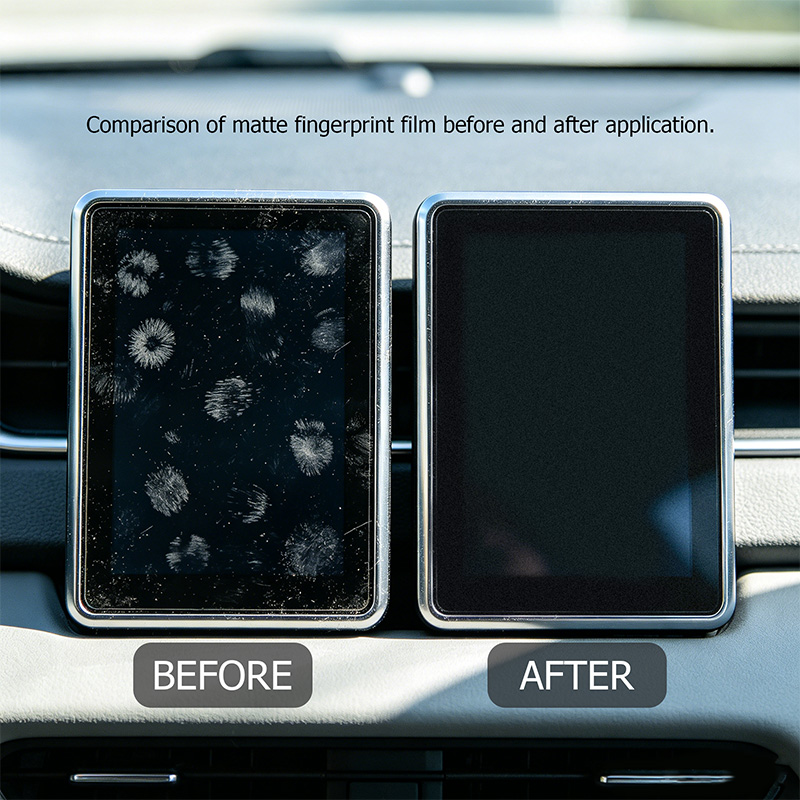
Q: Can the anti-fingerprint coating itself turn yellow?
A: The coating is nanometers thin and contributes negligible color on its own. Discoloration in a film product originates from the substrate or adhesive degrading under UV exposure. Mr. Film's UV-resistant construction addresses that root cause.
Q: Why do some anti-fingerprint films yellow while others do not?
A: The difference is UV stabilization. Films manufactured without UV-stabilized PET or adhesive can yellow within months. Mr. Film’s film incorporates UV-resistant technology to prevent that outcome.
Q: Will Mr. Film's anti-fingerprint film change the color temperature of my screen?
A: No. The film maintains 99% optical clarity and does not introduce a color cast. Its function is to repel oils and smudges, not to alter the display's output.
Q: How can I tell if a film is likely to yellow before buying?
A: Ask for UV resistance documentation. A product claiming anti-fingerprint performance without stating UV stability leaves the substrate and adhesive unprotected. Mr. Film's documentation explicitly links its anti-fingerprint function to UV-resistant protection against yellowing.
Q: Does Mr. Film's film work on curved screens without discoloration at the edges?
A: The product is designed with adaptive curvature support for flat, curved, and concave displays, with precision-cut edges that maintain optical consistency across the surface.
Q: What about heat? Can high temperatures cause discoloration?
A: Mr. Film's film is rated for -40°C to 85°C and resists heat and cold without peeling or deformation. Thermal stability is part of the same durability profile that prevents discoloration.


